Skip to content
Hayward KiserThe Working Lawn Field Library

A practical lawn almanac by Hayward Kiser

Know when your lawn is ready for the work

A bag can name a month. It cannot see compacted soil, inactive roots, a shaded corner, or next week’s rain. This regional calendar helps you decide when to seed, feed, inspect, repair, or simply wait.

The Soil Test

PDF

71 pages · 9 chapters

Hayward Kiser
The Year-Round Lawn Calendar

PDF · 71 pages

68Pages
9Chapters
$19Your order

The Working Lawn Field Library

The calendar says go. The lawn says otherwise.

Most wasted lawn work begins with a reasonable task done under the wrong conditions. Before opening a bag or filling a spreader, look at the grass, soil, moisture, weather, and growing cycle.

  • A warm Saturday arrives, but the soil is cold or saturated and the roots are not ready to use fertilizer.
  • Seed is spread over hard ground without reliable seed-to-soil contact, so thin patches stay thin despite watering.
  • A brown area is treated as drought damage when the real cause may be dormancy, weak roots, disease, or scalping.
  • Moss, grubs, or dog spots prompt a quick product purchase before shade, drainage, compaction, moisture, or soil condition is checked.

The book

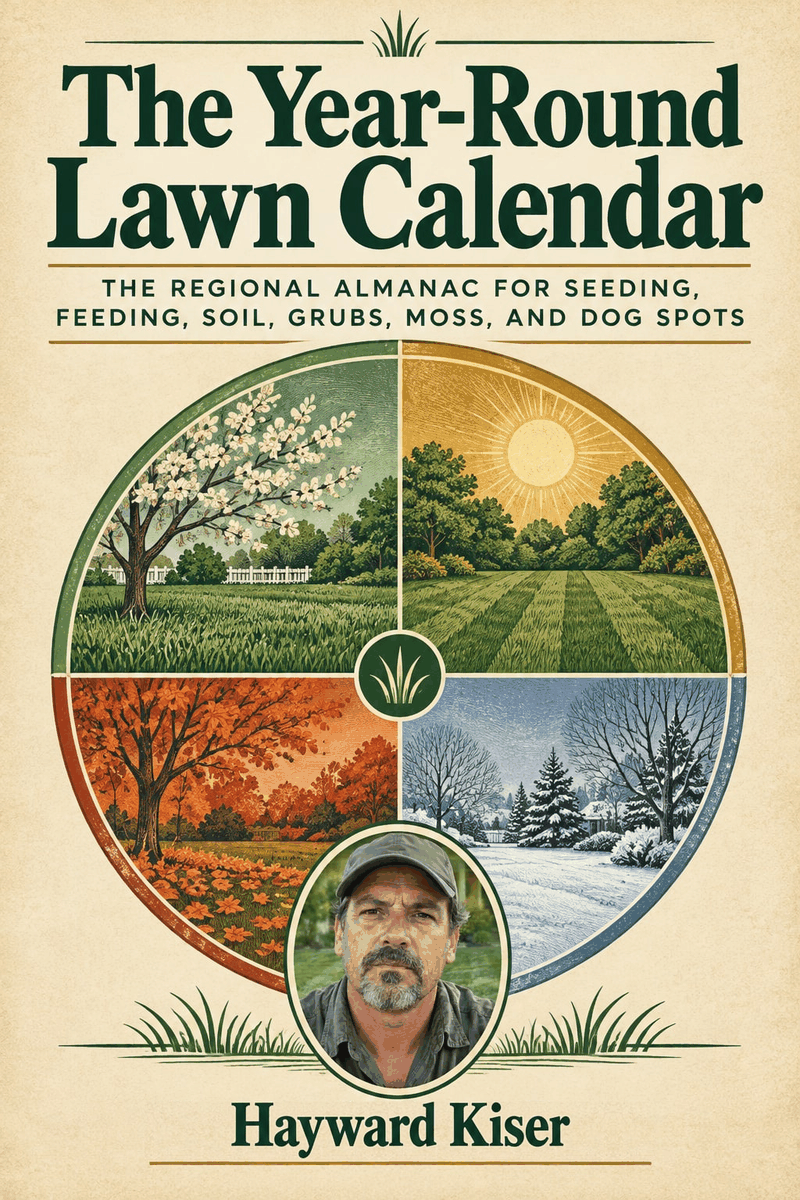
The Year-Round Lawn Calendar

The Year-Round Lawn Calendar

The book / 01

The Year-Round Lawn Calendar

The Regional Almanac for Seeding, Feeding, Soil, Grubs, Moss, and Dog Spots

The date is only a guide: do the job when the grass, soil, moisture, and forecast can support it.

The Year-Round Lawn Calendar is a 71-page working almanac for homeowners who want to match lawn care to actual growing conditions. Its 9 chapters begin with grass type, region, present condition, and weather, then move through The Soil Test, seeding, feeding, and seasonal schedules for cool-season, transition-zone, and warm-season lawns. You will also learn how to distinguish likely grub injury from drought or weak roots, read moss as a site-condition signal, repair dog spots, and keep a useful monthly record. The book is laid out to make the guidance easier to revisit when the forecast changes or a familiar patch starts behaving differently.

Selected chapters

  1. Start With the Lawn You Actually Have
  2. The Soil Test That Prevents Guesswork
  3. Seed Is a Timing Decision
  4. The Cool-Season Calendar
  5. The Transition-Zone Calendar
  6. The Warm-Season Calendar
  7. Feed the Growth, Not the Calendar
  8. Grubs and Moss: Diagnose Before You Buy

Selected chapters

Three ways into the working year

You can read straight through or begin with the decision already waiting in your yard. Each route leads back to the same habit: diagnose first, check the weather, and perform only the work the grass can use.

  1. Start with the lawn you actually have

    Identify the broad grass group, regional growing cycle, current condition, drainage, shade, and compaction. Choose the closest regional calendar, then adjust it by observing the yard rather than treating a boundary or date as rigid.

  2. Use The Soil Test before buying amendments

    Collect representative samples, submit them to a laboratory, and use the results to understand pH and nutrient conditions. Keep soil structure in view: wet, shallow, compacted, or salty ground can still defeat otherwise sensible lawn work.

  3. Match seed and feed to active growth

    Check site readiness, seed-to-soil contact, germination moisture, rainfall, irrigation capacity, and the forecast. Then decide whether the lawn needs patching, overseeding, renovation, measured feeding, or a deliberate pause.

Look inside

Open a page and read the working method

The sample pages show how the book moves from observation to a decision: identify the grass, inspect the site, check soil moisture and weather, then choose the suitable seasonal task. You can also examine the cover, Hayward’s portrait, interior previews, and reader illustrations before buying.

71 pages · 9 chapters

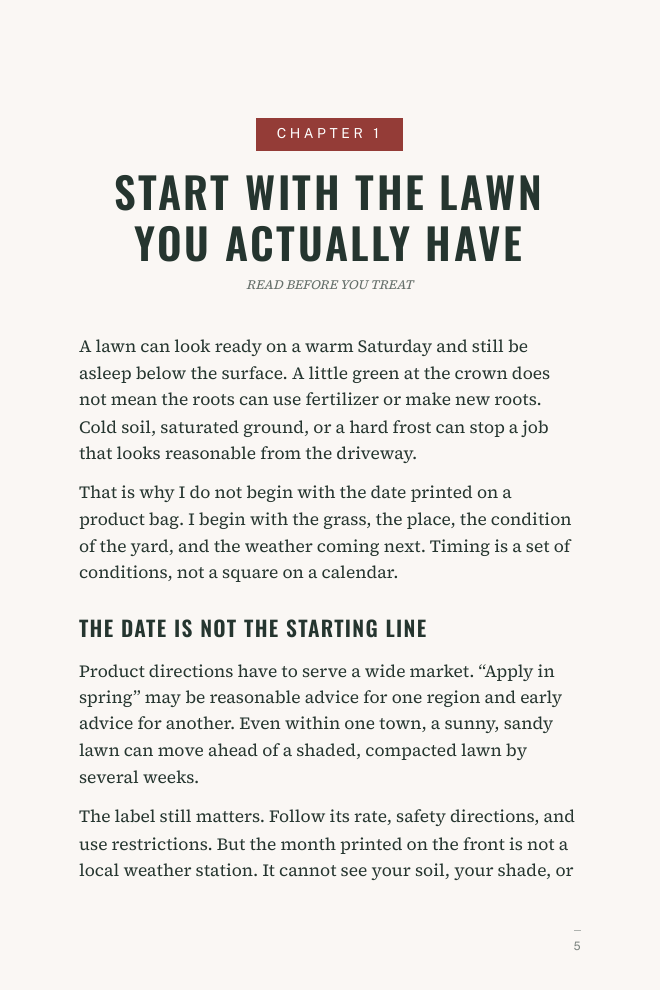
Page 6 — Start With the Lawn You Actually Have
Page 6 — Start With the Lawn You Actually Have ↗
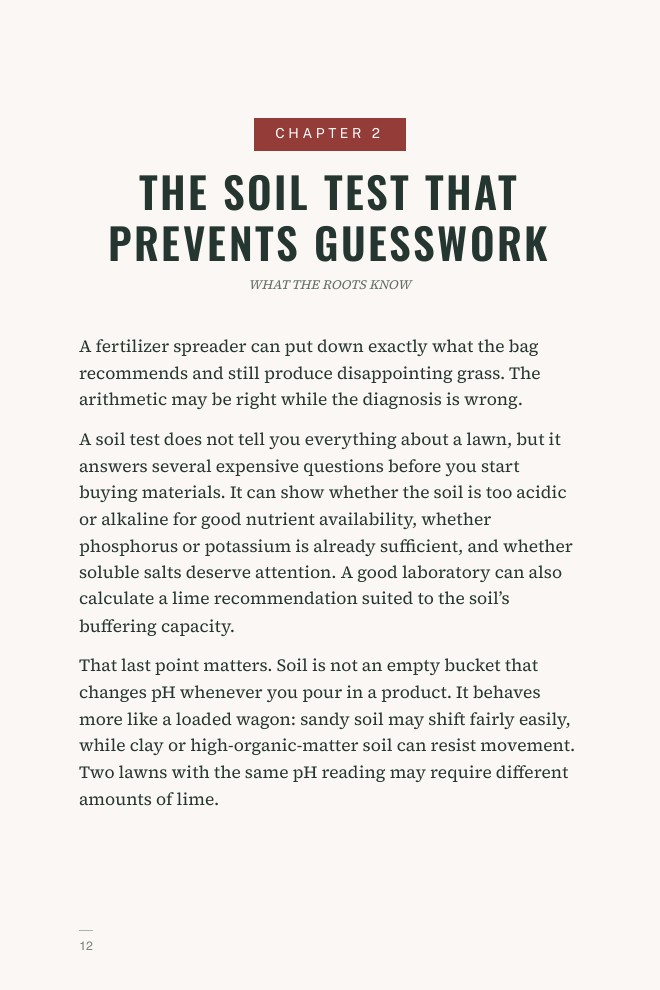
Page 13 — The Soil Test That Prevents Guesswork
Page 13 — The Soil Test That Prevents Guesswork ↗
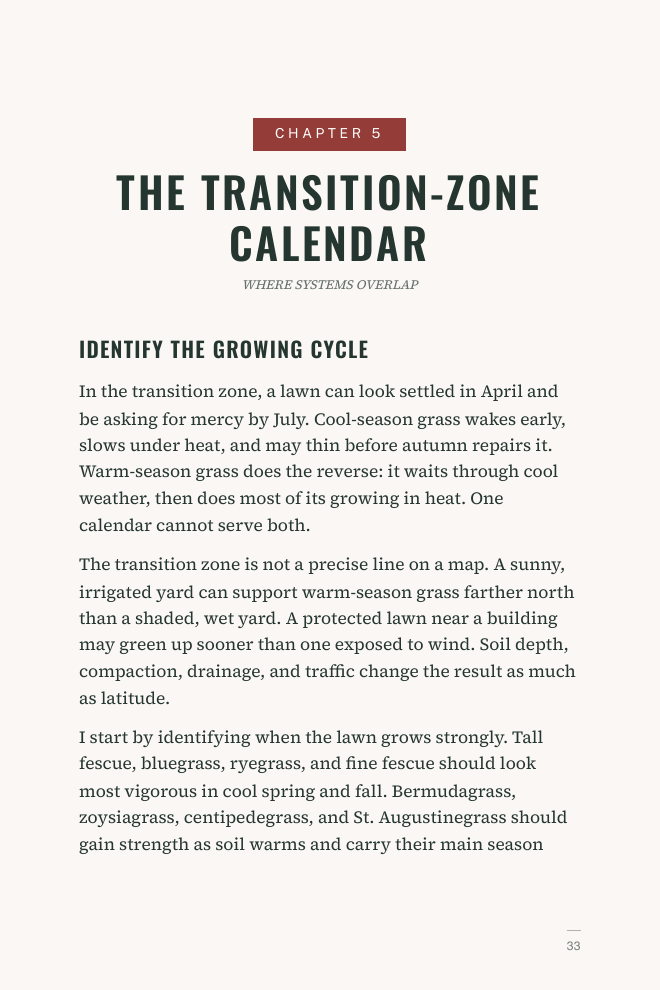
Page 34 — The Transition-Zone Calendar
Page 34 — The Transition-Zone Calendar ↗
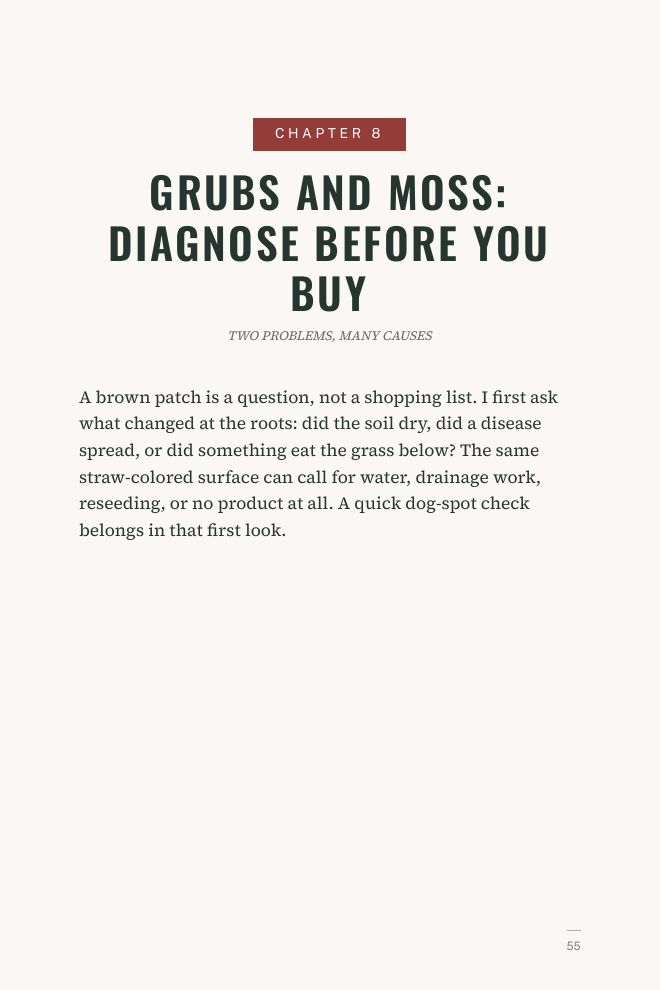
Page 56 — Grubs and Moss: Diagnose Before You Buy
Page 56 — Grubs and Moss: Diagnose Before You Buy ↗
Hayward Kiser

From Hayward

Notes from a suburban lawn and a working notebook

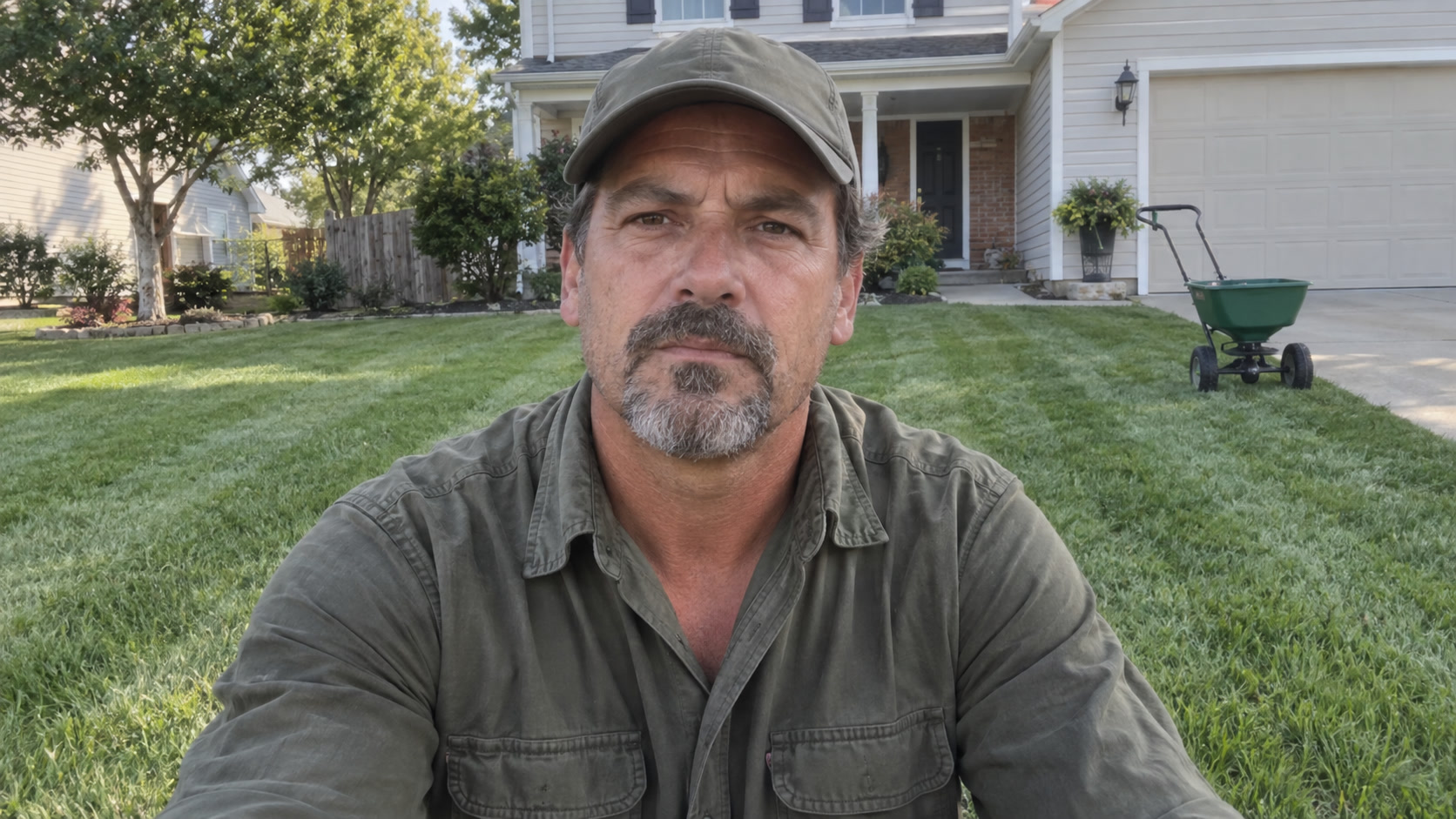
I have spent years maintaining residential lawns and doing practical grounds work in a suburban neighborhood. I have worked on grass thinned by drought, traffic, compaction, poor timing, and ordinary household use. Biscuit, my sixty-pound yellow Labrador, makes sure dog spots are not an abstract subject around here.

My father, Clarence, maintained the ballfield at my high school, and he taught me to pay attention to the ground beneath the grass. My daughter Naomi has heard more weather-and-soil talk than she probably requested. I wrote this calendar because steady observation is more dependable than chasing miracle products: note what the lawn is doing, check the conditions, make one suitable correction, and keep a record.

— Hayward Kiser

This is for you if

Who I wrote this for

This is for you if

  • You maintain a residential lawn and want a repeatable way to decide what belongs in the current season.
  • You know the basics but still hesitate over seeding windows, fertilizer timing, brown patches, moss, grubs, or dog spots.
  • You prefer regional guidance that can be adjusted for weather, shade, soil moisture, elevation, and the condition of your own yard.
  • You are willing to observe, take notes, use a soil laboratory when needed, and let stressed grass recover before adding more work.

What this book will not do

  • It will not give one date for every yard. Regional boundaries and calendars are guides; you adjust for grass activity, soil, rain and the short forecast.
  • It does not replace a laboratory soil test or your local Extension office for exact local advice.
  • It does not replace the product label. Follow the label for rates, safety directions and restrictions.
  • It will not fix a lawn with a live cause. Seed over compaction, deep shade, grubs or disease just fails a second time.
  • Lime and other soil amendments are not a substitute for nitrogen fertilizer, and nitrogen cannot replace water.

What you get

One regional calendar for the working lawn

The Year-Round Lawn Calendar is supplied as a PDF. The book includes 71 pages, 9 chapters, and practical guidance for cool-season, transition-zone, and warm-season lawns. Use it as a field reference for seeding, feeding, soil work, diagnosis, repair, weather checks, and monthly recordkeeping.

The Year-Round Lawn Calendar

Your order

The Year-Round Lawn Calendar

$19

PDF · 71 pages

$19 USD · 7-day money-back guarantee

71 pages · 9 chapters

  • The Year-Round Lawn Calendar · 71 pages · PDF
Get the lawn calendar $19

PDF

The Working Lawn Field Library

What you can work toward

AI-generated illustrations of potential readers.

Choose the right week to seed

Use grass type, regional growth patterns, site preparation, seed-to-soil contact, and moisture to distinguish a useful seeding window from a merely convenient weekend.

AI-generated illustrations of potential readers.

Feed without treating the bag as a calendar

Connect fertilizer decisions to active growth, soil-test findings, rainfall, and irrigation capacity. Read the label carefully, avoid unnecessary phosphorus, and recognize when an application should wait.

AI-generated illustrations of potential readers.

Investigate a stubborn patch before treating it

Compare signs of drought, dormancy, weak roots, grubs, moss, compaction, shade, drainage trouble, and dog urine injury before choosing the next repair.

AI-generated illustrations of potential readers.

Companion books

Complete the set

Fix Any Bare Spot

Companion book

Fix Any Bare Spot

A handbook for reading a bare patch before you touch it: dog, grubs, disease, shade or compaction. Then make seed touch soil, choose seed or sod, and protect the first four weeks.

The Working Lawn Field Library

Questions

How is the book organized?

Nine chapters: your lawn and region, the soil test, seeding timing, calendars for cool-season, transition-zone and warm-season lawns, feeding, grubs and moss, and dog spots with weather checks and a working year.

Do I need lawn-care experience to use this book?

No advanced experience is assumed. The book begins with broad grass groups, regional growing cycles, current lawn condition, soil, and weather. It explains the decisions in plain terms while still giving experienced homeowners a more orderly way to plan and record their work.

Does the book cover my region and grass type?

It provides separate calendars for cool-season, transition-zone, and warm-season lawns. Grasses discussed include tall fescue, Kentucky bluegrass, perennial ryegrass, fine fescue, bermudagrass, zoysiagrass, centipedegrass, and St. Augustinegrass. The regional boundaries are guides, not rigid lines.

Will this tell me exactly what to do on a particular date?

It will show what commonly belongs in each part of the growing year, but it does not treat a date as a command. You will learn to adjust the work for grass activity, soil moisture, recent rain, overnight lows, frost risk, heat, drought, shade, and the short forecast.

What does The Soil Test help me decide?

The Soil Test covers representative sampling, laboratory submission, and practical interpretation of pH and nutrient results. It can help identify whether phosphorus or potassium is already sufficient and whether salts or pH deserve attention.

Does it cover grubs, moss, and dog spots?

Yes. The book explains how to separate likely grub injury from drought, disease, and weak roots; how moss can point to shade, moisture, drainage, compaction, or unsuitable grass; and how to rinse dog-urine injury before reseeding the affected soil.

Why pay for the book when lawn-care videos are free?

A video can demonstrate one task, but this book puts the decisions in a complete working order: identify the lawn, understand the soil, choose the regional calendar, check the weather, diagnose the problem, and record the result. It stays together as a reference when you are standing at the shed or potting bench.

What format is available?

The available format is PDF. The Year-Round Lawn Calendar contains 71 pages.

Is there a money-back guarantee?

Yes. Every order has a 7-day money-back guarantee. To ask for a refund, just reply to the purchase email you got from Hotmart. A real person answers. The book is a PDF download; no printed copy is included.
Take the calendar outside and look at the ground

Begin with the lawn you actually have, not the lawn pictured on a bag. Check the grass, soil, moisture, and forecast; choose the job that fits; then write down what happened.

Get the lawn calendar $19

PDF